

Taking the First Steps With Confidence
Being named an executor of an estate can feel like both an honor and a heavy responsibility. If you are looking for the first steps after becoming an executor, you may already be wondering where to begin. There may be a house to protect, bills to organize, bank accounts to identify, family members to contact, and court paperwork to understand.
The good news is that you do not have to solve everything on the first day.
The best approach is to slow down, get organized, and handle the estate in a logical order. In Georgia, probate courts have original jurisdiction over the probate of wills and administration of decedents’ estates. The exact steps, however, can depend on the estate and the circumstances involved.
This guide explains the first steps after becoming an executor in plain language. It focuses on organizing information, protecting property, understanding estate assets and estate debts, communicating with beneficiaries and heirs, and preparing for the broader Georgia probate process.
The goal is not to rush through estate administration. Instead, it is to create a reliable foundation so each decision can be made with better information.
First Steps After Becoming an Executor: Understand Your Role
The first thing to understand is that being named in a will and being formally authorized to act for an estate are not necessarily the same thing.
Georgia law explains that a will can name an executor who submits the will to probate court and helps carry out the person’s wishes. If no executor is named, the probate court can appoint someone.
A Georgia government resource also explains that a person named as executor in a will is nominated by the deceased but does not become officially appointed until the court issues the appropriate authority, such as letters testamentary.
That distinction is important.
Until you understand your legal authority, avoid assuming that you can immediately sell property, close accounts, distribute money, or make other major decisions simply because your name appears in the will.
Confirm Your Appointment and Authority
One of the most important first steps after becoming an executor is confirming where the estate stands in the probate process.
If the will has not yet been submitted, the process may be at an earlier stage. If you have already been appointed, you may have received documentation establishing your authority.
Your first organizational task should therefore be to gather information about the appointment.
Consider collecting:
- A copy of the will.
- The death certificate.
- Probate case information.
- Letters testamentary or other appointment documents, if issued.
- Contact information for the appropriate probate court.
- Contact information for the estate attorney, if one is involved.
- Information about co-executors or other personal representatives.
- A secure folder for court correspondence.
These documents matter because they help establish where the estate is in the process and who has authority to act.
Before making major decisions about estate property or money, confirm your appointment and understand the authority granted to you.
Read our blog What are the Executor Duties to understand the process of appointing a executor or administrator for managing the estate. Learn the responsibilities of the personal representative and the role of the probate court.
Create an Estate Administration File
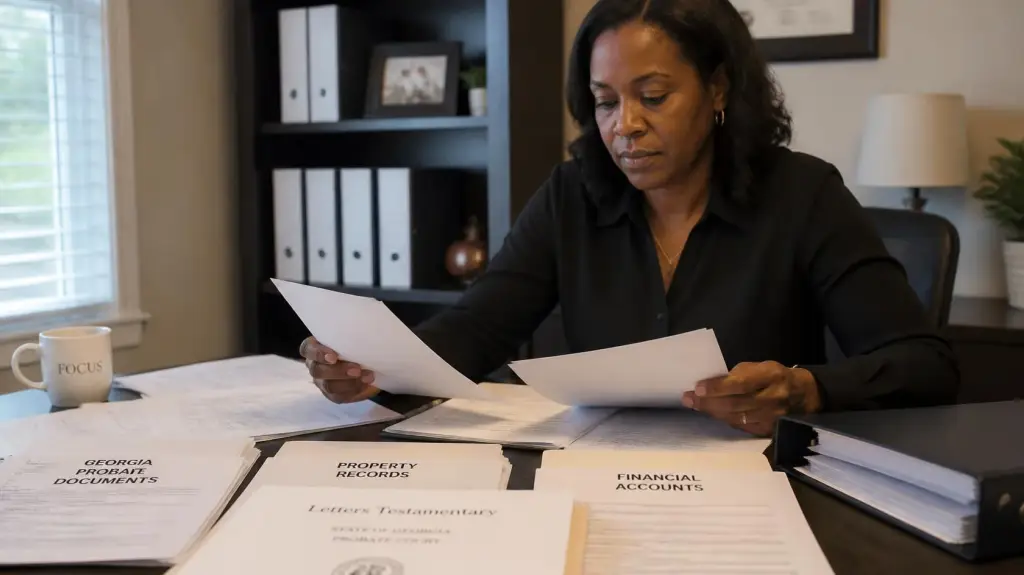
Once your role is clear, create one central location for the estate’s records.
This can be a physical binder, a secure digital folder, or both. The important thing is consistency. Everyone who is authorized to receive information should know where records are maintained.
A well-organized file can include:
- Probate court documents.
- The will and other estate planning documents.
- Death certificate copies.
- Bank statements.
- Investment statements.
- Property records.
- Mortgage information.
- Insurance policies.
- Tax documents.
- Bills and creditor notices.
- Vehicle titles.
- Business records.
- Beneficiary information.
- Heir information.
- Receipts for estate expenses.
- Correspondence related to the estate.
Georgia Courts maintains standard probate forms and directs users to Georgia probate resources for additional information.
The purpose of the file is simple: you should be able to answer, “Where is that document?” without searching through piles of paperwork.
Create your estate file before trying to tackle every individual task. Organization at the beginning can save substantial time later.
Read our blog What is Georgia Probate Inventory. Learn how to organize, collect supporting records and why good record-keeping can help prevent confusion, disputes, and liabilities.
Protect the Estate Assets

After establishing your role, turn your attention to the estate assets.
The estate may include much more than money in a bank account. Georgia government guidance recommends identifying assets such as real estate and personal property when organizing estate information.
Start by making a list of everything you know about.
Your preliminary asset list may include:
- A home or other real estate.
- Bank accounts.
- Investment accounts.
- Retirement accounts.
- Vehicles.
- Jewelry.
- Collectibles.
- Furniture and household property.
- Business interests.
- Life insurance information.
- Digital financial accounts.
- Safe-deposit boxes.
- Personal loans owed to the deceased.
- Other valuable property.
This first list does not have to be perfect. Its purpose is to identify what exists so you can investigate ownership and determine how each item should be handled.
Do not assume that every asset must go through probate. Some property may pass through joint ownership, beneficiary designations, trusts, or other arrangements.
That is why the executor’s job begins with identification and organization, not immediate distribution.
Build a Complete Estate Inventory
After making the initial asset list, develop a more detailed estate inventory.
An inventory gives you a central record of what the estate owns, where the property is located, what documents support ownership, and what additional information is still needed.
Georgia Courts materials describe estate cases as involving management of a decedent’s assets, liabilities, and property.
Your working inventory can use categories such as these:
| Category | Information to Record | Follow-Up Question |
|---|---|---|
| Real estate | Address, deed, mortgage | Who owns it and is there debt? |
| Bank accounts | Institution and account type | Is it individually owned or jointly held? |
| Investments | Institution and statements | Is there a beneficiary? |
| Vehicles | Title, make, model, loan | Who is listed on the title? |
| Personal property | Description and estimated value | Does it have significant value? |
| Business interests | Company and ownership records | Does professional valuation apply? |
| Insurance | Policy and beneficiary information | How are proceeds handled? |
| Other assets | Description and documents | Does the asset require probate? |
The table is a working organizational tool. It does not determine the legal treatment of an asset.
For each asset, keep supporting documentation whenever possible. A bank statement, deed, title, account statement, or other record can be much more useful than a handwritten note saying an asset exists.
Identify Estate Debts
Executors must pay attention to what the estate owes as well as what it owns.
Estate debts may include mortgages, credit cards, medical bills, personal loans, taxes, utility charges, property expenses, and other obligations.
Georgia Courts describes estate cases as involving assets, liabilities, and property, reinforcing why both sides of the financial picture matter during administration.
Begin by creating a debt list.
Look for:
- Mortgage statements.
- Credit-card statements.
- Medical bills.
- Personal loan documents.
- Vehicle loans.
- Property tax notices.
- Utility bills.
- Insurance invoices.
- Homeowners association charges.
- Business obligations.
- Tax correspondence.
- Other creditor communications.
Do not assume that every bill should be paid personally by you. Your role is to administer the estate according to applicable law and the authority granted to you.
Instead, document the claim and discuss questions about payment with the estate’s attorney or other qualified professional.
Keeping a record of each obligation also helps prevent missed bills and duplicate payments.
Identify the Beneficiaries and Heirs
Another early task is understanding who may have an interest in the estate.
The words beneficiaries and heirs do not always mean exactly the same thing.
A beneficiary is generally someone who receives property or benefits under a will, trust, account designation, or other arrangement. An heir generally refers to a person entitled to inherit under applicable inheritance law, particularly when someone dies without a valid will.
Georgia law explains that a will identifies beneficiaries and can state what those beneficiaries should inherit.
As executor, you should organize the information without immediately assuming that every person mentioned in family conversations is legally entitled to receive estate property.
Create a contact list containing:
- Full names.
- Mailing addresses.
- Email addresses, when appropriate.
- Telephone numbers.
- Relationship to the deceased.
- Whether the person is identified in the will.
- Relevant notes about communications.
This list should be handled carefully because estate information can be sensitive.
Most importantly, avoid promising a beneficiary a particular asset or amount before the estate’s obligations and legal requirements are understood.
Create a beneficiary and heir information sheet, but let the will, probate process, and applicable law guide distribution decisions instead of making informal family promises.
Read our blog How are Assets Distributed to learn about transferring assets to the beneficiaries or heirs. Understanding the responsibilities involving estate assets and distributions.
Understanding Probate Property
Not all property is necessarily handled in the same way.
Probate property generally refers to property that is subject to administration through the probate estate. Other assets may transfer through a separate mechanism.
For example, Georgia government information explains that certain assets, including some jointly owned accounts and certain beneficiary-designated assets, may not require the same probate treatment.
This distinction can prevent a common mistake: assuming that everything the deceased owned should simply be divided among the people named in the will.
Instead, classify assets carefully.
| Property Type | Initial Question |
|---|---|
| Individual account | Is the account titled only in the deceased's name? |
| Joint account | Is another owner listed? |
| Retirement account | Is there a beneficiary designation? |
| Life insurance | Who is the named beneficiary? |
| Real estate | How is title held? |
| Trust property | Is the asset owned by a trust? |
| Vehicle | Whose name appears on the title? |
| Personal property | Does the will specifically address it? |
The appropriate treatment should be confirmed when there is uncertainty.
Secure and Manage Estate Property
Physical property can require immediate attention.
A house may need lawn care, utilities, insurance, security, repairs, or regular inspections. A vehicle may need to be secured. Valuable personal property may need protection.
The executor should therefore determine what needs attention without unnecessarily changing or disposing of property.
For real estate, consider documenting:
- Current condition.
- Utility status.
- Mortgage information.
- Insurance coverage.
- Property taxes.
- Security arrangements.
- Maintenance needs.
- Occupancy.
- Repairs.
- Valuable items located inside.
This information can become part of the estate’s records.
If the estate owns probate property, maintaining it may be an important part of protecting the estate’s value while administration continues.
Estate Expenses: Keep Every Receipt
Estate expenses can accumulate quickly.
There may be court fees, professional fees, property costs, insurance, utilities, repairs, storage, transportation, postage, and other administration-related expenses.
Create an expense log from the beginning.
Record:
- Date.
- Description.
- Amount.
- Payment method.
- Person or company paid.
- Supporting receipt.
- Reason for the expense.
This record matters because you may need to explain how estate funds were used.
It also helps separate estate transactions from your personal finances.
A simple rule is useful: keep estate money and personal money separate, and retain documentation for transactions involving estate funds.
Start the expense log with the first estate-related payment rather than waiting until tax or court paperwork is due. If you need a template, Download our Free Georgia Probate Kit.
The kit includes resources that can help with navigating the probate process, organizing records, and tracking expenses to make the process manageable.
Build Your First 30-Day Executor Plan
After the initial organization, create a simple 30-day plan.
You do not need to complete every estate task in a month. The purpose is to establish control over the information and identify the issues that require professional attention.
During the first several weeks, focus on the following:
- Confirm your appointment and legal authority.
- Secure the original will and important estate documents.
- Obtain necessary death certificate copies.
- Identify the appropriate Georgia probate court.
- Create your master estate file.
- Begin the estate asset inventory.
- Start the estate debt list.
- Identify beneficiaries and potential heirs.
- Secure real estate and valuable personal property.
- Review insurance coverage.
- Record ongoing estate expenses.
- Identify mortgages, loans, taxes, and recurring bills.
- Contact financial institutions as appropriate.
- Make a list of questions for the estate attorney or other professionals.
The reason for working from a list is simple. Executors often have many responsibilities competing for attention. A written plan makes it easier to separate urgent tasks from decisions that can wait.
Use the first 30 days to organize facts, not to rush distribution. A complete picture of the estate is more valuable than a fast but incomplete decision.
Read our blog How Estate Debts & Expenses are Handled to understand what the estate owns and owes. Learn how to manage and review estate claims and expenses before making distributions.
Georgia Probate Process: Know What Comes Next
The Georgia probate process is handled through the appropriate probate court, but the exact requirements can vary with the estate.
Georgia Courts states that probate courts have original jurisdiction over probate of wills and administration of decedents’ estates.
The probate process may involve petitions, appointment of a representative, management of estate assets and liabilities, required notices or filings, and eventual distribution or closing of the estate, depending on the circumstances.
Georgia probate courts also have different local responsibilities and procedures. The Council of Probate Court Judges notes that probate courts administer wills and estates but also cautions that the Council does not provide legal advice about specific proceedings.
Therefore, an executor should identify the specific court handling the estate and follow the instructions applicable to that proceeding.
If you are unsure which form or filing applies, asking the court or a qualified Georgia probate attorney is safer than guessing.
Common Mistakes New Executors Should Avoid
New executors often make mistakes because they are trying to help their families.
However, good intentions do not eliminate the need for careful administration.
Watch for these common problems:
- Distributing money before understanding the estate’s debts.
- Selling property before confirming authority.
- Giving away personal property without documenting it.
- Mixing estate funds with personal funds.
- Ignoring mail from creditors or government agencies.
- Failing to protect vacant property.
- Assuming every asset goes through probate.
- Assuming every asset avoids probate.
- Making promises to beneficiaries before the estate is evaluated.
- Losing receipts for estate expenses.
- Destroying financial documents too soon.
- Treating verbal family agreements as substitutes for legal documents.
These mistakes can create unnecessary conflict. A slower, documented approach is usually easier to explain and defend.
Estate Documents: Create a Master Document List

Good estate documents management can make the entire process easier.
Instead of keeping documents in multiple places, create a master list showing what you have and what is missing.
Important records may include:
- Original will.
- Codicils or amendments.
- Death certificates.
- Probate filings.
- Letters testamentary.
- Deeds.
- Mortgage records.
- Bank statements.
- Investment statements.
- Retirement account information.
- Insurance policies.
- Vehicle titles.
- Tax returns.
- Business records.
- Bills and creditor notices.
- Receipts for estate expenses.
- Property maintenance records.
- Beneficiary information.
- Correspondence with professionals and institutions.
Georgia Courts provides standard probate forms and related resources, making it useful to distinguish official court paperwork from informal family records.
How an Executor Can Work With Family Members
Family communication can be one of the hardest parts of estate administration.
Different family members may have different expectations. One person may want to keep the family home. Another may prefer to sell it. Someone else may be concerned about personal belongings.
As executor, your job is not simply to make everyone happy.
Instead, communicate clearly, keep records, and follow the governing documents and applicable legal requirements.
A useful communication approach includes:
- Explain what stage the probate process has reached.
- Share appropriate information consistently.
- Avoid promising specific distributions too early.
- Keep important decisions documented.
- Refer legal disagreements to the appropriate professional.
- Give beneficiaries reasonable updates when appropriate.
- Keep personal disagreements separate from estate records.
Clear communication does not eliminate every family disagreement. However, it can reduce confusion about what is happening.
When Should an Executor Get Professional Help?
Some estates are straightforward. Others are not.
Professional help may be particularly important when the estate involves significant real estate, business ownership, substantial debts, disputes among family members, unclear ownership, complicated tax questions, or uncertainty about beneficiary rights.
Consider asking for professional assistance when:
- You are unsure whether probate is required.
- You do not understand your authority.
- A beneficiary disputes the will.
- An heir cannot be located.
- The estate owns multiple properties.
- The estate has substantial debt.
- A business interest is involved.
- There are questions about taxes.
- Property ownership is unclear.
- Someone claims ownership of estate property.
- A beneficiary designation conflicts with family expectations.
- You are unsure how to handle a court filing.
Georgia Courts specifically advises people with questions about a specific proceeding to contact the court where the proceeding is pending, while legal questions should be directed to an appropriate legal professional.
FAQ: First Steps After Becoming an Executor in Georgia
What are the first steps after becoming an executor?
The first steps after becoming an executor generally include confirming your appointment and authority, securing important documents, protecting estate property, identifying assets and debts, organizing beneficiaries and heirs, and creating a record of estate expenses.
What is an executor of an estate?
An executor of an estate is generally the person named in a will to handle estate administration, subject to the applicable probate process and court appointment. Georgia law explains that a will can name an executor who submits the will to probate court and helps carry out the deceased person’s wishes.
When does an executor officially have authority in Georgia?
Being named in a will does not necessarily mean the person has already been formally appointed. A Georgia government resource explains that an executor named in a will is nominated until the court issues the applicable authority, such as letters testamentary.
What should an executor do with estate assets?
An executor should identify, protect, document, and properly administer estate assets according to the applicable legal process. The executor should not automatically distribute assets simply because family members agree.
What are estate debts?
Estate debts are financial obligations associated with the deceased person or the estate. They can include mortgages, credit cards, medical bills, loans, taxes, and other obligations.
Do all estate assets go through probate?
No. Certain assets may transfer through joint ownership, beneficiary designations, trusts, or other arrangements. The exact treatment depends on how each asset is owned and the applicable documents and law.
What is probate property?
Probate property is property that is subject to administration through the probate estate rather than transferring automatically through another legal mechanism. The executor should verify the treatment of individual assets rather than making assumptions.
Who are beneficiaries and heirs?
Beneficiaries are people or organizations designated to receive benefits under a will, trust, account, policy, or other arrangement. Heirs generally refers to people who inherit under applicable inheritance law, particularly when someone dies without a valid will.
Should an executor pay estate expenses personally?
An executor should keep estate transactions separate from personal finances and maintain records of estate expenses. Questions about whether a specific expense should be paid from estate funds should be directed to the appropriate professional.
Where does the Georgia probate process take place?
Georgia probate courts have original jurisdiction over probate of wills and administration of decedents’ estates. The appropriate court depends on the circumstances of the estate.
Conclusion: Organization Is the Best First Move
The first steps after becoming an executor do not have to involve solving the entire estate.
Begin by confirming your authority. Then secure the estate documents, create an estate inventory, identify estate assets and estate debts, organize information about beneficiaries and heirs, and protect the estate’s physical property.
From there, you can work through the Georgia probate process one step at a time.
Remember that being an executor of an estate is a responsibility, not a race. A careful executor keeps good records, separates estate funds from personal money, communicates clearly, and asks for professional guidance when an issue goes beyond basic organization.
Most importantly, do not feel pressured to make every decision immediately. The strongest beginning is usually a simple one: understand your role, gather the facts, protect what the estate owns, document what it owes, and create a clear plan for the work ahead.