



Understanding a Georgia Probate Inventory
A Georgia Probate Inventory helps identify property belonging to a person who has died and is subject to administration by the estate’s personal representative. Depending on the estate, that property may include real estate, vehicles, personal property, financial assets, and other property. For families, the inventory can provide an organized starting point for understanding what the estate owns.
In Georgia, an executor or administrator may have a duty to prepare and file an inventory with the Probate Court. However, the requirement can depend on whether the inventory has been waived and on the circumstances of the estate. Georgia’s standard probate materials state that, unless an inventory has been waived, a personal representative must file an inventory within six months after qualification and provide a copy to heirs or beneficiaries within the same period.
This article explains what a Georgia Probate Inventory is, when an executor or administrator may need to prepare one, what types of property should be considered, how to keep supporting records, and why an accurate inventory can make the rest of the estate administration easier for the family.
Why a Georgia Probate Inventory Matters

When someone dies, family members may know about the house, car, furniture, or bank account. However, the personal representative may need to look much deeper. Some assets are easy to see, while others can be hidden in financial records, business documents, safe-deposit information, or old paperwork.
A probate inventory creates a written record of the estate property that is subject to administration. Georgia’s standard probate documents describe the inventory as covering property, both real and personal, as well as debts of the estate in applicable circumstances.
The inventory can also help prevent confusion between family members. Instead of relying on memory, everyone involved can work from a documented list.
If you are helping settle an estate, start by creating a master list of everything the person owned. Do not worry about making it perfect on the first day. The goal is to create a starting point that can be checked and updated as information is discovered.
Read our blog What is Georgia Estate Settlement. Learn about managing a deceased person’s property, financial obligations, and distribution according to applicable Georgia law. Understand why organizing and collecting supporting documents can make the process more manageable.
What Goes Into a Georgia Probate Inventory?
A Georgia Probate Inventory is not limited to the family home. Estate property can take many forms. The personal representative should carefully investigate the deceased person’s financial and property records and determine which assets are part of the probate estate.
Real Estate in the Estate
Real estate can be one of the most valuable assets in an estate. It might include a primary residence, rental property, undeveloped land, commercial property, or another interest in real property.
The inventory should provide enough information to identify the property clearly. Supporting documents may include deeds, tax records, mortgage information, closing documents, or other records.
Real estate deserves special attention because ownership can be complicated. A property may be jointly owned, subject to a survivorship arrangement, or otherwise pass outside the probate estate. Therefore, simply seeing the deceased person’s name on a document does not always answer the question of whether the property belongs on the probate inventory.
Vehicles and Other Transportation
Cars, trucks, motorcycles, boats, recreational vehicles, and similar property may need to be considered as estate assets.
The personal representative should locate titles, registrations, loan information, insurance records, and other documents that help establish ownership.
A vehicle can also raise practical questions. Should it be sold? Should it be distributed to a beneficiary? Is there a loan? Does the title need to be transferred?
Keeping these questions with the estate inventory can help the family avoid losing track of the vehicle while other probate matters are being handled.
Personal Property and Belongings
Personal property can include furniture, jewelry, artwork, electronics, collectibles, tools, household items, firearms where legally applicable, and other belongings.
Not every item needs the same level of detail. However, valuable or disputed property deserves particularly careful documentation.
For example, a family may know that a deceased parent owned an expensive piece of jewelry. If one person receives it, the estate records should make that distribution clear.
An inventory can therefore do more than list possessions. It can help connect property identification with later estate administration and distribution.
Bank Accounts and Financial Assets
Financial assets may include checking accounts, savings accounts, certificates of deposit, investment accounts, stocks, bonds, and other financial interests.
The personal representative should review financial records carefully. Some accounts may pass directly to a named beneficiary or joint owner rather than through probate. Others may belong to the probate estate.
Because of these differences, families should avoid assuming that every account associated with the deceased automatically belongs in the probate estate.
Other Assets That May Need Review

Some assets do not fit neatly into the categories above. These can include business interests, money owed to the deceased, royalties, refunds, certain digital or intellectual property interests, or other property rights.
The personal representative’s investigation should be broad enough to identify property that may not be sitting inside a house or bank account.
This is one reason an inventory of estate assets is useful. It encourages the executor or administrator to look at the entire financial picture rather than focusing only on obvious belongings.
Before preparing the final inventory, walk through the major property categories one at a time. This simple approach can make it easier to notice an asset that might otherwise be overlooked.
Read our blog What is Final Estate Accounting to understand how to identify the remaining assets that are still held by the estate. Learn what information to gather and document to show what happened to the estate during administration.
How an Estate Inventory Helps the Family
A properly prepared Georgia Probate Inventory can benefit more than the Probate Court. It can also give family members a clearer understanding of the estate.
It Creates a Record of Estate Property
The personal representative has a responsibility to keep good records. Georgia probate materials require a personal representative, when an inventory is not waived, to provide the inventory to the court and heirs or beneficiaries within the applicable six-month period.
That record can become an important reference as the estate moves forward.
For example, if the inventory identifies a house, two vehicles, furniture, investment accounts, and other assets, the family can later compare those assets with sales, transfers, distributions, and remaining property.
It Helps Track What Happens to Assets
An inventory is a snapshot. Estate administration is the story that follows.
A house might later be sold. A vehicle might be distributed. A bank account might be closed and the funds transferred into the estate account. Personal belongings might be distributed among beneficiaries.
Keeping a record makes those changes easier to follow.
Georgia’s probate system includes accounting functions, and Georgia probate materials also require supporting vouchers to be retained for annual accountings when those accountings are required.
It Can Reduce Family Disagreements
Estate disputes sometimes begin with uncertainty rather than bad intentions.
A family member might say, “I thought there were two cars.” Another might remember a valuable coin collection. Someone else may wonder what happened to an investment account.
A detailed estate inventory does not guarantee that disagreements will disappear. Nevertheless, it gives everyone a documented starting point.
Inventory Does Not Mean Every Asset Is Probate Property

This distinction is extremely important.
A person can own an asset at death without that asset necessarily being administered through the probate estate. Joint ownership, beneficiary designations, trusts, and other legal arrangements can affect how property passes.
Therefore, the personal representative should not automatically include every item discovered during the investigation as a probate asset without determining how the property passes.
When the ownership or transfer method is unclear, professional legal advice can help prevent mistakes.
Keep copies of documents supporting each major asset. If a property is later sold or distributed, the original inventory and supporting records can help explain what happened.
Read our blog What are the Executor Duties to understand how executor or administrator become appointed by the probate court. Learn what responsibilities they must carry-out to manage the estate and how the court is involved.
Creating a Practical Georgia Probate Inventory
Preparing an estate inventory can feel overwhelming, especially when the family is already dealing with grief. Breaking the work into smaller steps can make it more manageable.
Start with documents. Then move to physical property. Finally, compare everything you find against financial records and the requirements of the specific estate.
Start With the Major Property Categories
A useful first pass should identify the broad categories of property. Consider the following list as an organizational tool:
- Real estate: homes, land, rental property, and other real property interests.
- Vehicles: cars, trucks, motorcycles, boats, and other titled property.
- Personal property: furniture, jewelry, electronics, collectibles, artwork, and household belongings.
- Financial assets: bank accounts, investments, certificates of deposit, and other financial interests.
- Business interests: ownership interests in companies, partnerships, or other businesses.
- Other assets: money owed to the deceased, refunds, royalties, or other property rights.
This first list matters because broad categories help the personal representative identify what needs closer investigation.
Record Useful Details for Each Asset
Once an asset is identified, record enough information to distinguish it from other property.
For example, a vehicle record might include the year, make, model, title information, and relevant loan information. A real estate record might identify the property address and ownership documents.
For personal property, photographs may be helpful when an item is valuable or likely to become disputed.
The exact information needed can vary. Therefore, the personal representative should follow the applicable Probate Court requirements and any instructions provided in the estate’s case.
Keep Supporting Documents
The inventory should not be treated as a stand-alone document. Supporting records can provide evidence behind the information listed.
Important records may include:
- Deeds and property documents.
- Vehicle titles and registrations.
- Bank and investment statements.
- Appraisals or valuation records.
- Purchase or ownership documents.
- Insurance information.
- Business records.
- Photographs of valuable personal property.
- Other documents showing ownership.
The reason this matters is simple: if someone later asks how an asset was identified or valued, the personal representative has a record to review.
Know the Six-Month Inventory Rule
One of the most important timing issues for a Georgia Probate Inventory is the six-month period.
Georgia’s standard form instructions state that, unless the inventory has been waived, the personal representative must file the inventory within six months after the date of qualification and deliver a copy to the heirs or beneficiaries within that same period.
The word “unless” matters. Not every estate necessarily follows the same inventory requirement. A waiver or other court-specific circumstance can change the filing obligation.
Therefore, an executor or administrator should review the actual appointment documents, court orders, will, waivers, and applicable Probate Court instructions rather than assuming that every estate has identical requirements.
Keep the Inventory Updated in Your Estate Records
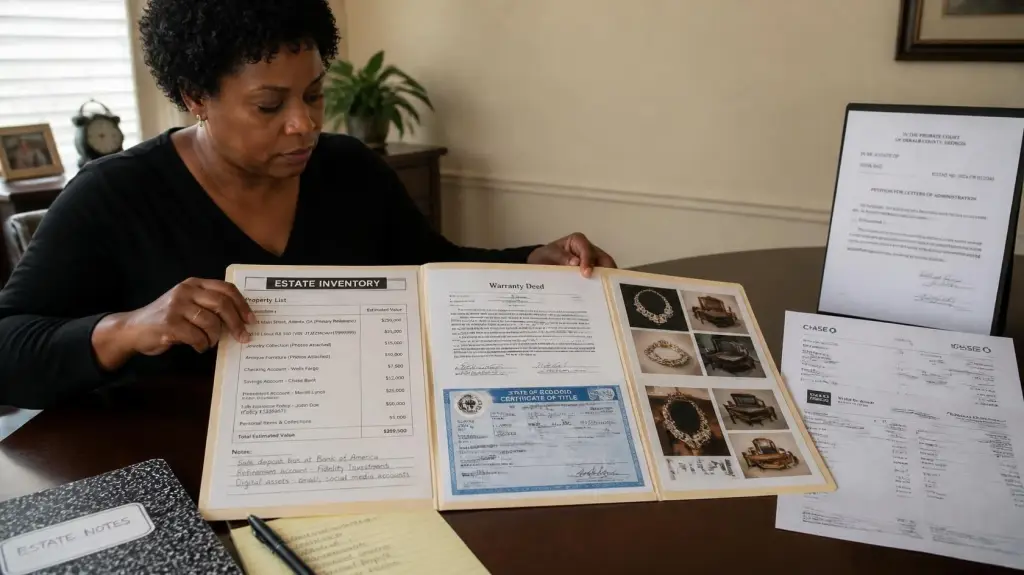
The personal representative should keep a reliable record of the inventory and related documents throughout administration.
If an asset is sold, transferred, or distributed, the representative should retain documentation showing what happened.
Similarly, if another asset is discovered, the representative should determine whether an updated filing or other court action is necessary.
This recordkeeping can become especially important when the estate later moves toward accounting and final distribution.
Once the inventory is prepared, compare it against the estate’s financial records and physical property. If something is missing or ownership is unclear, investigate it before moving ahead with major distributions.
Read our blog What are the First Steps of Executor about how to prepare an estate during the Georgia probate process. Learn how to identify where the estate is in the process and who has authority to act.
Frequently Asked Questions About Georgia Probate Inventory
What is a Georgia Probate Inventory?
A Georgia Probate Inventory is a record identifying property and, in applicable circumstances, debts of an estate that are subject to administration. It can include real estate, vehicles, personal property, financial assets, and other estate property.
Does every Georgia estate require an inventory?
Not necessarily. Georgia’s standard probate instructions state that an inventory must be filed unless the inventory requirement has been waived. The instructions also state that, when required, the inventory is generally due within six months after the personal representative qualifies.
Who prepares the probate inventory?
The personal representative generally handles the inventory. Depending on the estate, the personal representative may be an executor or administrator.
What property should be included in an estate inventory?
Property may include real estate, vehicles, personal belongings, financial assets, business interests, and other property that is subject to probate administration. However, not everything a person owned necessarily passes through probate.
Are vehicles included in a Georgia probate inventory?
A vehicle that is part of the probate estate may need to be included. The personal representative should review title, ownership, loan, and transfer information.
Is personal property included in an estate inventory?
Yes, personal property can be part of an estate inventory. Valuable or disputed items may deserve additional documentation, such as photographs, descriptions, or valuation records.
When is a Georgia probate inventory due?
Georgia standard probate instructions state that, unless waived, an inventory must be filed within six months after the personal representative’s qualification, with a copy delivered to heirs or beneficiaries within the same period.
Does the executor have to keep records?
Yes. Good recordkeeping is an important part of estate administration. Georgia probate instructions specifically address retaining vouchers supporting the correctness of items in required annual accountings.
What happens if an asset is discovered after the inventory is prepared?
The personal representative should document the newly discovered property and determine what action is required under the particular estate’s circumstances. Depending on the situation, an amended filing or other Probate Court action may be appropriate.
Can an estate asset be excluded from probate?
Yes. Some property can pass outside probate through mechanisms such as certain joint ownership arrangements, beneficiary designations, or trusts. The personal representative should determine how an asset passes before assuming it belongs in the probate estate.
Conclusion: Keeping a Clear Record of the Estate
A Georgia Probate Inventory gives families a practical way to understand what property may be part of an estate and what the personal representative needs to manage.
The process begins by identifying major categories such as real estate, vehicles, personal property, financial assets, business interests, and other property. From there, the executor or administrator can gather ownership documents and create a clear record.
The inventory is also part of a larger process. Assets may later be sold, transferred, distributed, or used to pay legitimate estate expenses. Consequently, keeping the original inventory and supporting documents can help explain the estate’s financial and property history.
Georgia probate materials state that, unless an inventory is waived, it generally must be filed within six months after qualification and provided to heirs or beneficiaries within that period.
However, the exact requirements can depend on the estate. A family should therefore review the specific Probate Court case and applicable documents rather than relying on a general checklist alone.
The most important lesson is straightforward: identify the property, document what you find, keep supporting records, and update the estate file as assets change.
For an executor or administrator, careful recordkeeping can make later accounting, distribution, and estate-closing steps much easier.